Government Roles and Responsibilities

Municipal governments in Alberta are responsible for delivering essential local services, managing infrastructure, and supporting community development. They work alongside provincial (or territorial) and federal governments, each with distinct roles and responsibilities. Click here to download a Quick Guide.

Municipal government

Municipal governments, like Parkland County, establish rules and bylaws, and deliver services that support the municipality. Most often, municipal governments are cities or towns, but they can also be counties, villages, summer villages, municipal districts and improvement districts.

Municipal governments work to serve the needs of citizens. In Alberta, municipal governments are governed by the Municipal Government Act (MGA), which states that the purposes of municipalities are:

  • to provide good government
  • to provide services, facilities or other things that, in the opinion of council, are necessary or desirable for all or a part of the municipality
  • to develop safe and viable communities

Municipal councils are made up of elected councillors and a Chief Elected Official (Mayor). Councillors set policy and strategic direction for the municipality, while the Chief Administrative Officer (CAO) manages day-to-day operations. Over 270 people work for Parkland County to make sure the services it provides are taken care of efficiently and effectively.

Municipal governments are intrinsically involved in the everyday lives of the people they serve. They guide and oversee the issues, programs and services that most directly impact the day-to-day lives of its citizens.

Alberta’s Municipal Government Act has three main areas of focus:

  • Planning and development
  • Governance and administration
  • Assessment and taxation

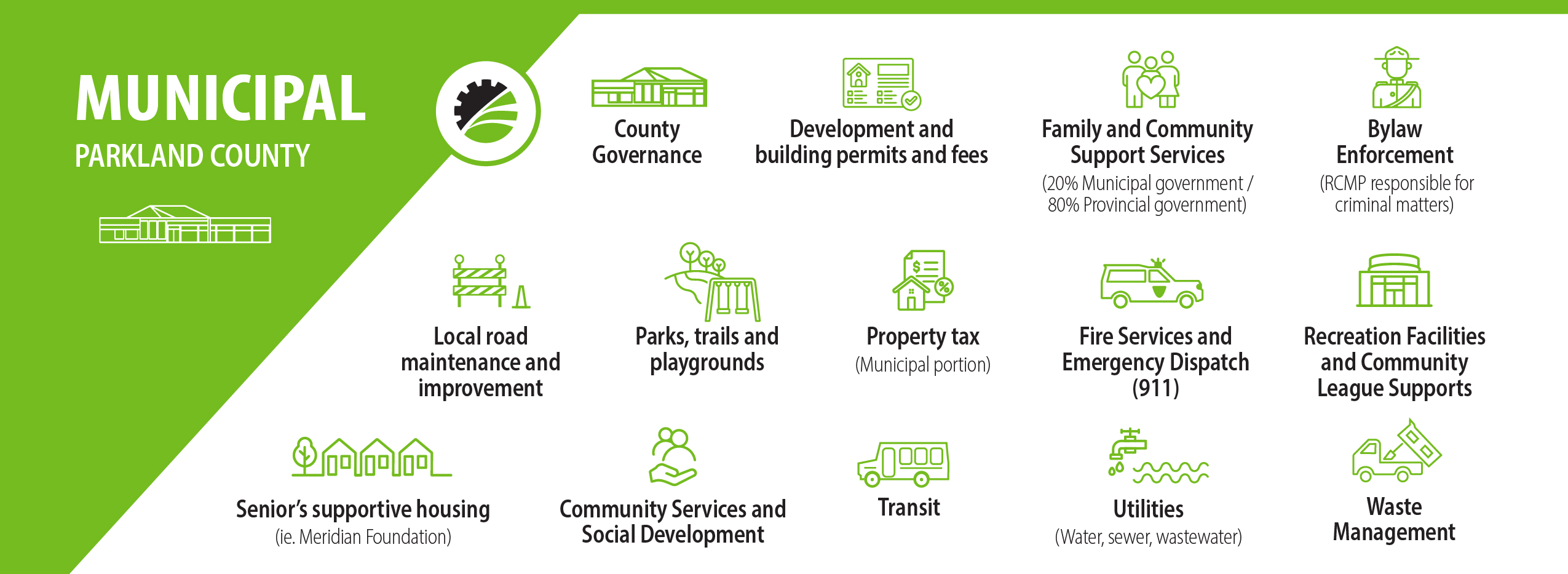
Within each of those areas, there are myriad roles, responsibilities, services and programs that municipalities develop, administer and assess, including:

  • County Governance
  • Development and building permits and fees
  • Family and Community Support Services (20% Municipal government/80% Provincial government)
  • Bylaw Enforcement (RCMP responsible for criminal matters)
  • Local road maintenance and improvement
  • Parks, trails and playgrounds
  • Property tax (Municipal portion)
  • Fire Services and Emergency Dispatch (9-1-1)
  • Recreation Facilities and Community League Supports
  • Senior's supportive housing (ie: Meridian Foundation)
  • Community Services and Social Development
  • Transit
  • Utilities (water, sewer, wastewater)
  • Waste management

These services make communities safe, livable, and sustainable. Municipalities also advocate for residents on issues like education and health care, which fall under other levels of government.

As the closest level of government to our citizens, municipalities are essential to creating healthy, sustainable communities. Municipalities are the places where Albertans build their families, their careers and their homes. It’s where people access the programs, facilities and services they need to live their lives and contribute to the economic prosperity of their municipality and this province and country.

Municipalities champion the wellbeing of their citizens and create opportunities for residents to contribute to decisions about the local issues that matter to them.

Make your opinion heard:

  • If you have questions or concerns about something going on in the County, let Council know by contacting the Councillor for your Division.
  • Come to a Council or Committee meeting. Learn more.

Remember to vote:

  • Once you turn 18, you can participate in the municipal election every four years. Residents vote for the Councillor in their Division and for the Mayor.
  • Voting is the most important part of democracy. It allows residents to keep their elected officials accountable. If a Councillor is doing a good job of representing their division, residents can re-elect them. If not, the residents have an opportunity to pick someone new.

Volunteer:

  • The Stony Plain Volunteer Centre provides support and services to the volunteers and organizations within Stony Plain, Spruce Grove and Parkland County. Visit the Town of Stony Plain’s website for current volunteer opportunities.

Provincial government

Provincial or territorial governments, like the Government of Alberta, have the authority to make decisions which affect the entire province or territory, but not the rest of Canada. This includes things like education, health care and hospitals, provincial taxes, and the age of majority.

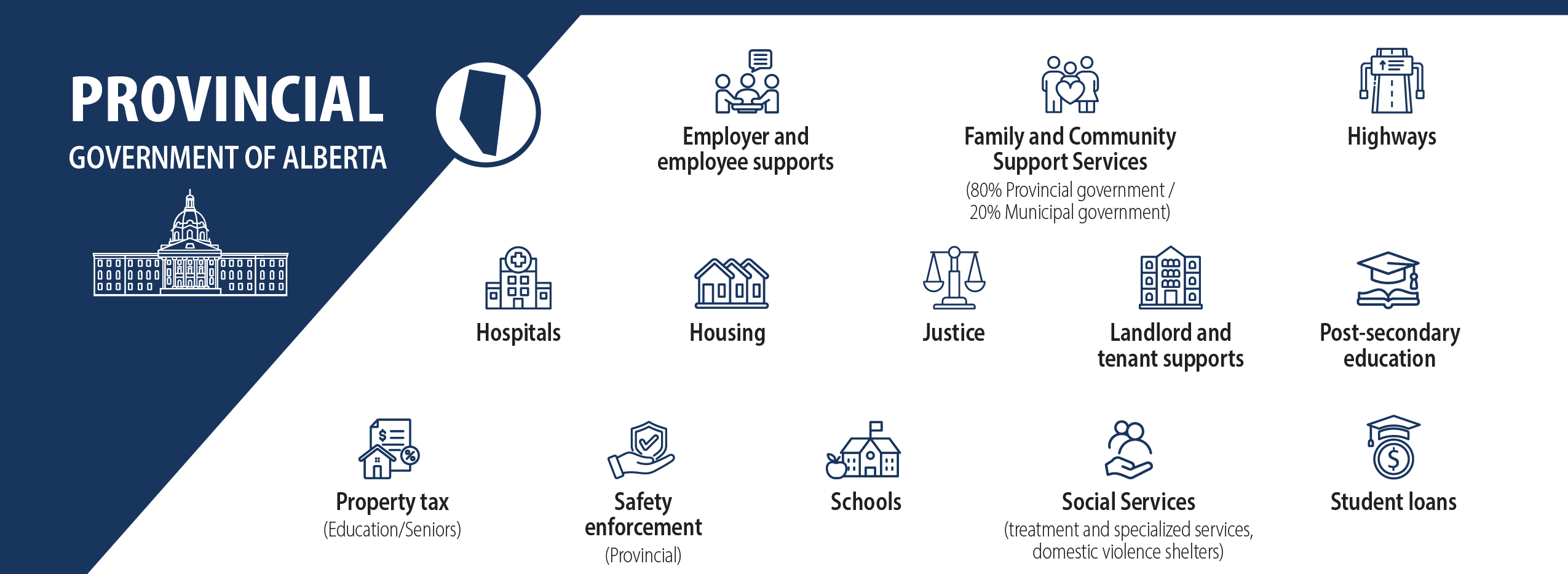
Provincial governments make decisions that affect the entire province. In Alberta, responsibilities include:

  • Employer and employee supports
  • Family and Community Support Services (80% Provincial government/20% Municipal government)
  • Highways
  • Hospitals
  • Housing
  • Justice
  • Landlord and tenant supports
  • Post-secondary education
  • Property tax (Education/Seniors)
  • Safety enforcement
  • Schools
  • Social Services (treatment and specialized services, domestic violence shelters)
  • Student loans

In the Province of Alberta, the Lieutenant Governor represents the monarch, the King of Canada, in the Crown's role as head of state. Lieutenant Governors are appointed by the Governor General on the advice of the Prime Minister of Canada.

Alberta is divided into 87 regions which are known as constituencies. During a provincial election (held every 4 years), the candidate in each constituency who wins the highest number of votes becomes the constituency representative as Member of the Legislative Assembly (MLA). The leader of the political party with the most winning candidates becomes the Premier of Alberta. The premier, as head of the elected government, governs the province on a daily basis in the monarch’s name.

Federal government

The Federal Government, also known as the Government of Canada, oversees things that affect the entire country, such as the postal service, national defense, the Supreme Court, passports, federal income tax, and employment insurance.

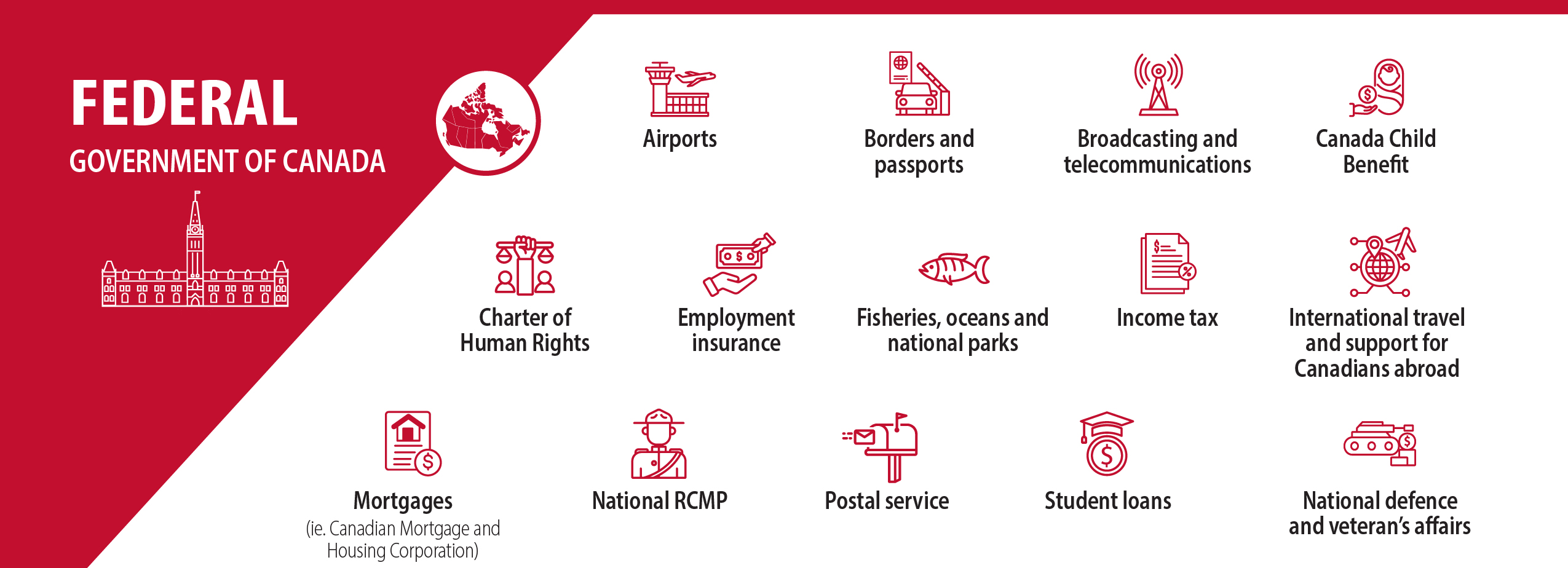
The federal government manages issues that affect Canada as a whole. Its responsibilities include:

  • Airports
  • Borders and passports
  • Broadcasting and telecommunications
  • Canada Child Benefit
  • Charter of Human Rights
  • Employment insurance
  • Fisheries, oceans and national parks
  • Income tax
  • International travel and support for Canadians abroad
  • Mortgages (ie: Canadian Mortgage and Housing Corporation)
  • National defense and veteran's affairs
  • National RCMP
  • Postal service
  • Student loans

Canada’s federal government is made up of three branches:

  • Executive: The King holds executive power, but in practice it is exercised by the Prime Minister and Cabinet on the King’s behalf. The Governor General represents the King in Canada and carries out ceremonial duties.
  • Legislative: Parliament includes the House of Commons and the Senate, along with the King (represented by the Governor General). Together, they debate and pass laws.
  • Judiciary: The Supreme Court of Canada and other federal courts interpret laws and ensure they align with the Constitution.

Federal elections are held every four years. Canadians elect Members of Parliament (MPs) to represent their ridings in the House of Commons. The leader of the party with the most MPs becomes the Prime Minister.

Contact Us

Parkland County Centre
53109A HWY 779, Parkland County, AB T7Z 1R1

General Office: 780-968-8888
Toll Free: 1-888-880-0858
After hours: 780-968-8400
Email: hello@parklandcounty.com

Report a Concern